
Madison County Weekly Arrest Sources
No single countywide booking log exists for Madison County. The best city source is the Oneida Police blotter archive. It offers date-range PDFs rather than a jail roster, and it skips agencies outside Oneida. For county coverage, use the Sheriff press-release page. New York State Police news carries selected matters only.
Chittenango's monthly reports count activity by category instead of naming people arrested each day. Wampsville fields no separate village police force and leans on county-level law enforcement. In a system this fragmented, the agency name matters as much as the person's name. Keep both in mind when you hunt for an arrest record.
Read Oneida Arrest Blotter PDFs
Begin with the date the event happened, not today's date. A single blotter PDF can span several days, and Oneida often posts it after the last incident it covers.
- Open the official Oneida Police archive and select a PDF whose date span includes the event.
- Read the incident date, alleged offense, location, and agency text in context.
- Do not assume a person remained jailed after the report was written.
- Check the relevant court or request the underlying police report for the later outcome.
The official archive screen displays the date-range document structure:
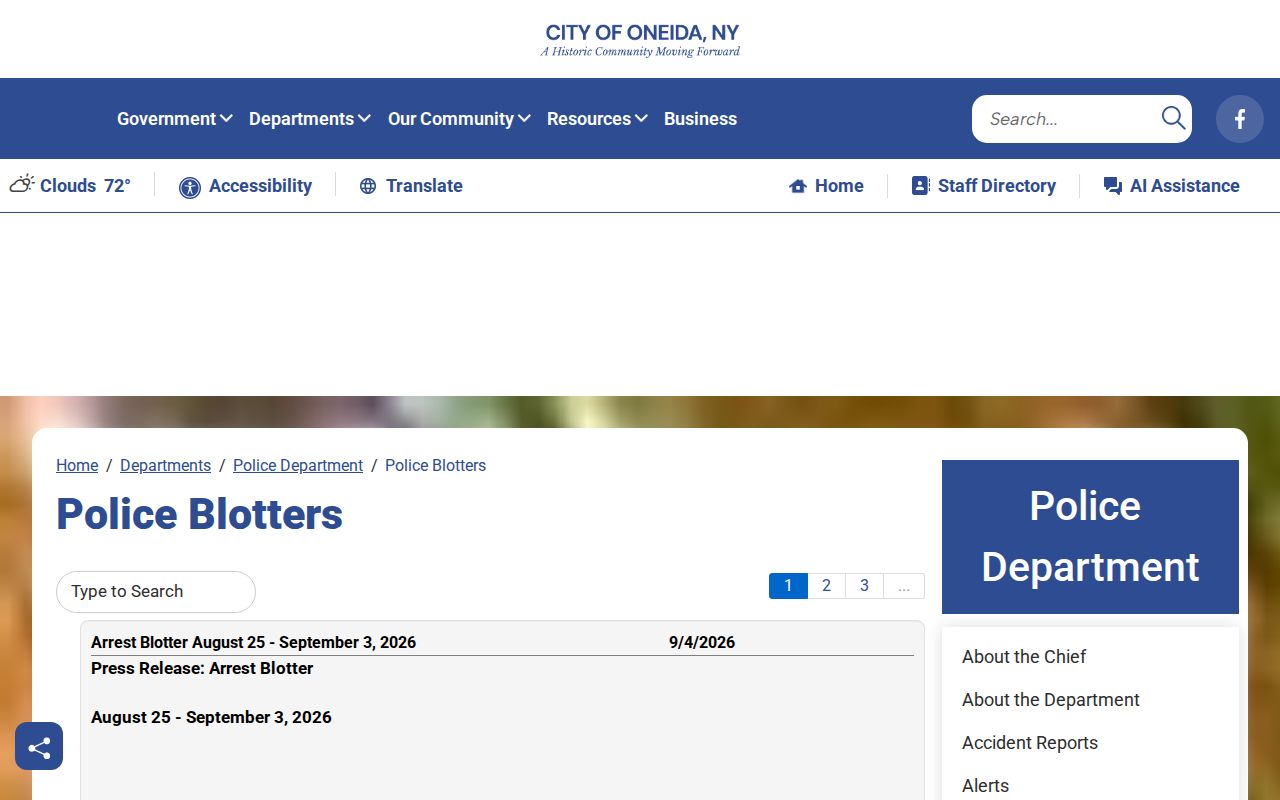
The linked PDFs are police publications, not booking-photo galleries.
Fields in Oneida Arrest Reports
Oneida's PDFs are narrative entries. Each lists a date, name, age, location, alleged charge, and release details such as an appearance ticket. No booking-photo gallery appears anywhere in the file. Juvenile-sensitive material should not be copied or republished.
| Entry field | How to read it |
|---|---|
| Date | Reported incident or arrest date within the PDF span |
| Name and age | Identifiers that still require careful matching |
| Location | Place tied to the reported event, not always the jail |
| Charge | An charge at that stage |
| Release language | Status when the report was prepared, not a lasting court result |
The official sample PDF shows those fields and its no-photo format:
The image illustrates how a record is laid out. It does not reproduce a booking portrait.
Weekend Madison County Arrest Reports
No official source shows a weekend arrest surge in Madison County. Nor does any office follow a Monday posting rule. Resist turning a common pattern into a local fact. What holds true is narrower. A multi-day PDF may group events across a span. Press releases may surface well after the arrest, and the county promises no posting cadence. Search the surrounding date ranges and note the publication date apart from the incident date.
Need custody answers fast? A weekly blotter is the wrong tool. Use the Sheriff's VINELink path or the jail status line instead. For something believed to have happened today, follow the Daily Arrest Report fallback.
Madison County Arrest Log Archives
Oneida's archive holds dated PDFs, but no guaranteed earliest year or permanent online depth. A missing PDF could mean the item moved. It may never have been posted. The file could also stay only with the agency. County press releases never add up to a full historical arrest index either.
New York's LGS-1 schedule sorts records into separate series. Arrest summary logs, case investigation files, and identification records are distinct. Some summary logs qualify as permanent, while case-file retention varies with outcome and offense type. Retention still promises nothing about web access. For an older record, FOIL the specific agency. Include the approximate date, person, incident, and record series.
Local News and Madison Arrests
CNY Online runs Oneida arrest-blotter summaries on an irregular schedule. Newport Dispatch covers Madison County arrests through stories. Both count as secondary sources. They may miss corrections or later court outcomes, and an article photo should not be assumed to be a booking photograph. The CNY Online blotter section works well as an index to check against police records.
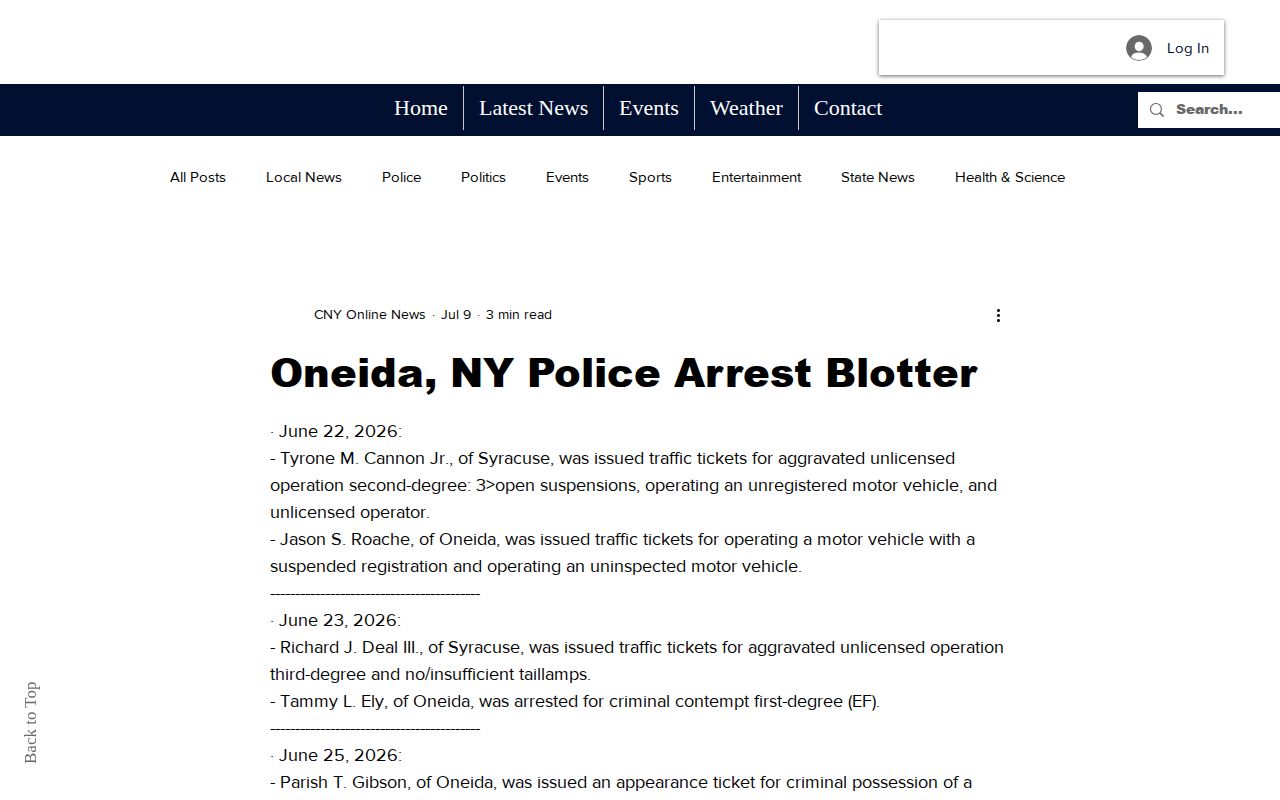
Treat the news date as a lead, nothing more, then verify with the agency or court.
Arrest Logs Do Not Show Guilt
A blotter records what an agency reported near the start of a case. The filed charge may change at arraignment. It can get reduced, dismissed, sealed, or resolve long after publication. Someone released can still sit in an old PDF. Someone in custody may be missing from that agency's log entirely. For the court result, check New York eCourts or WebCrims when applicable. The local clerk or a certificate of disposition works too. The countywide Madison County arrest records hub ties it together. It links custody, booking photos, FOIL, courts, and archives.
Agency Coverage in Madison Arrest Logs
A Oneida blotter reflects Oneida Police work. Chittenango's monthly report sums up village activity in the aggregate. Sheriff press releases cover selected county events, and State Police news covers selected trooper cases. None of these forms a master ledger. Search whichever agency likely handled the event, and keep publication dates separate from arrest dates.
The county's 2020 DWI report shows how crowded the enforcement map is. It credited arrests to the Sheriff, State Police, Oneida, Chittenango, and Canastota. State Park Police, Cazenovia, and SUNY Morrisville appear too. That table covers one offense category in a single year. It cannot serve as a current all-arrest count. It does explain why a single blotter misses most of Madison County.
Request an Unpublished Madison Arrest Entry
No public log for the date you need? Start by writing down the person's name, the event date, the location, the agency you think handled the arrest, and the record you want. From there, the request itself is straightforward. Madison County FOIL governs anything the county holds. The Sheriff FAQ spells out the terms: five business days for a statutory response, $0.25 per page, and $5 for a photograph. A reply can take several forms, too. The office may acknowledge the request, set a later reasonable date, hand over the records, or cite a lawful reason to withhold them.
Custody matters more than people expect. A police report, a jail booking record, a booking photo, and a court disposition can each sit with a different office, so file narrowly with each one that applies. For older files, ask which LGS-1 record series covers them and whether the file is active, archived, sealed, transferred, or disposed. An online absence tells you none of that.
Compare Madison Arrest Dates Correctly
Dates trip people up on Madison County arrest searches. One blotter entry can carry three of them at once: the incident or arrest date, the range the document covers, and the day the agency posted the file. News adds its own publication date. Jail records add booking and release times. The court adds arraignment and disposition dates. Sort every result by date type before concluding an entry is missing or late.
That discipline pays off after a weekend. Open the PDF range holding the event, then check the ranges on either side, plus any agency release you can find. Then go to the report custodian. A name missing from Oneida's blotter does not rule out an arrest by the Sheriff, State Police, Chittenango, or another agency. A later docket can carry a changed charge, and an old PDF never updates itself when a case ends.
When you cite a blotter, keep the original PDF title and its covered dates intact. Pulling a name alone strips away the label. It also loses the source date that gives it meaning. For a corrected or sealed case, go back to the agency and the court. The archived PDF is not the final word. A records officer can tell you whether an older file is still available. They can also explain which retention series applies.
Save the agency URL along with the document date. News summaries move or lose context over time. A stable citation names the publishing office and the date range it covers. When sources conflict, weight the agency record. Prefer the court outcome over any secondary story.